
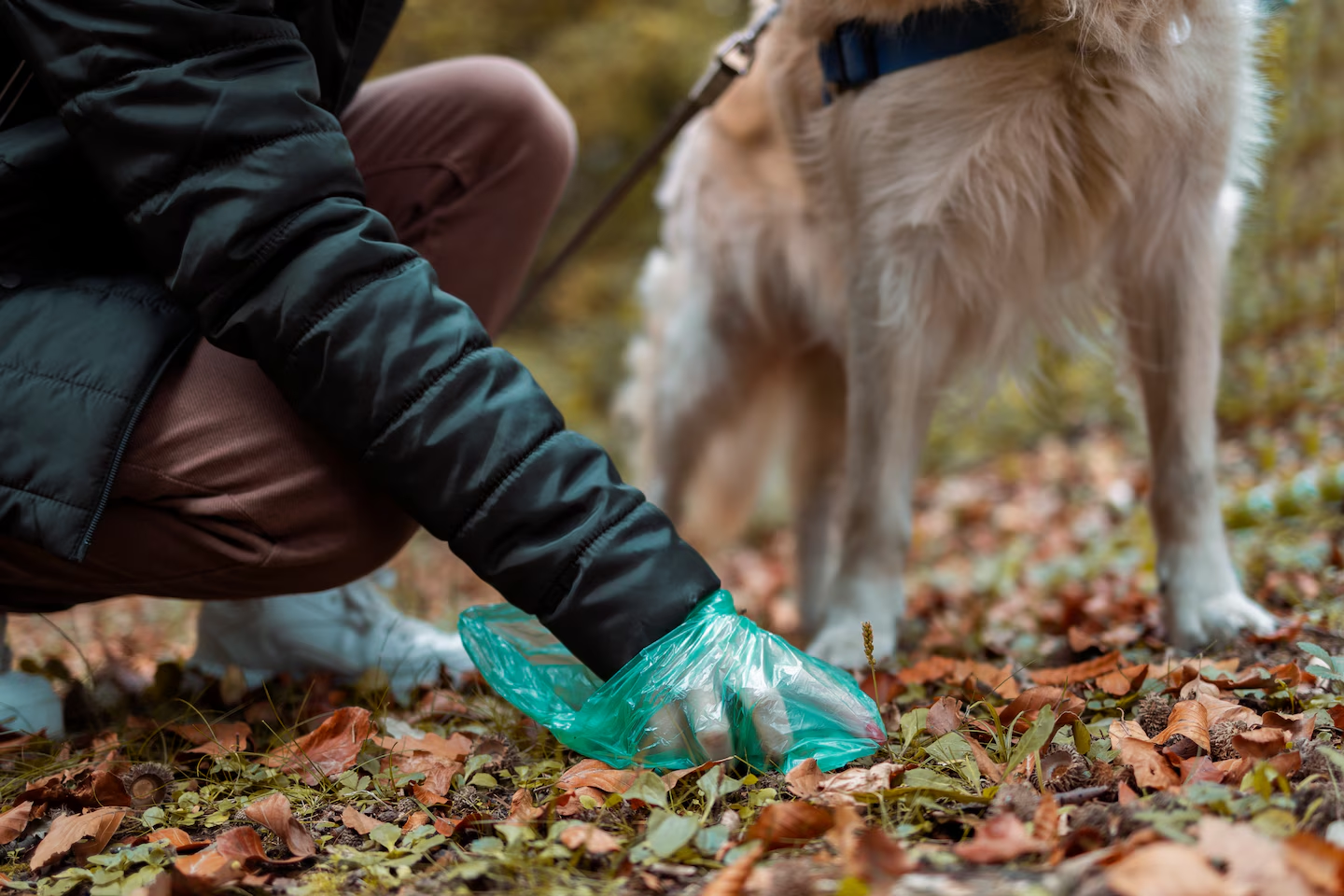
There are few things capable of ruining a perfectly good walk quite as efficiently as stepping in dog poop.
One moment you’re enjoying the fresh air. The next you’re scraping the sole of your shoe against the nearest patch of grass while questioning humanity.
We’ve all been there.
And yet… somehow… it keeps happening.
Because while living with dogs is full of joy, connection, and muddy pawprints on your freshly cleaned floor, there’s one part that sits firmly at the less glamorous end of the dog ownership spectrum.
Dealing with their poop.
It’s certainly the less-photographed side of dog ownership.
But it matters — far more than most people realise.
A closer look at what you’re picking up
To understand why picking up after our dogs matters, we first need to get slightly more acquainted with what we’re actually picking up. I appreciate this wasn’t how you planned to spend your afternoon, but stick with me.
Dog poop is made up largely of water — roughly 75% of it, in fact. The rest is a surprisingly complex mixture of undigested food particles, dietary fibre, fats, proteins, billions of gut bacteria, metabolic waste products, and cells naturally shed from the digestive tract. The problem is that dog waste can also contain less welcome passengers, including bacteria and parasites such as E. coli, Salmonella, Giardia, and roundworms. And importantly, these aren’t limited to visibly sick dogs. Even healthy-looking dogs can carry and shed pathogens without showing any obvious signs of illness.
Which means that pile left behind on the grass isn’t just unpleasant — it can be a genuine health risk for other dogs, wildlife, and humans. And unlike stepping in it, that’s a consequence that’s much harder to scrape off your shoe.
Children are particularly vulnerable. They spend more time on the ground, touch everything, and (let’s be honest) hand hygiene isn’t always their top priority.
And then there’s the dogs themselves.
For dogs with a coprophagia habit (yes, the delightful hobby of eating poo), it becomes a very tempting snack. If the original dog was carrying parasites or pathogens, that’s an easy transmission route.
And then… your dog comes back, tail wagging, ready to give you a big affectionate lick.
I’ll let you connect those dots.
The journey of a forgotten poo
Understanding what dog waste contains is only part of the picture. The next question is what happens to it once it’s left behind.
There’s a common belief that if you leave it, nature will take care of it. Unfortunately, the story doesn’t end once the poop hits the ground.
Here’s what actually happens.
Rain hits. The waste breaks down. Nutrients, bacteria, and parasites can then be carried through soil and into stormwater systems, eventually reaching rivers, lakes, and beaches.
In other words, that pile doesn’t stay where it was left.
A study in Sydney linked dog faeces washed into stormwater systems to poor water quality at a local swimming beach, particularly following rainfall events. That contamination can lead to illnesses like gastroenteritis in swimmers and beachgoers.
So that “it’s just one poop” moment?
It doesn’t stay in one place.
It moves through entire systems – and the impact doesn’t stop at water quality.
Good for the soil? Not quite…
This is one of the most persistent myths surrounding dog poop.
Because it’s natural, many people assume it must also be beneficial.
Unfortunately, that’s not the case.
Dogs eat nutrient-dense, protein-rich diets, which means their waste contains high concentrations of nitrogen and phosphorus. While those nutrients might sound helpful, in excess they can disrupt the delicate balance of natural ecosystems.
Research from Ghent University showed that dogs contribute significant nutrient loads to natural areas through their urine and faeces. Instead of supporting ecosystems, these inputs can favour fast-growing, aggressive plant species that outcompete native plants, ultimately reducing biodiversity.
In other words, the plants most likely to benefit aren’t necessarily the ones we want more of.
The same research found that simply picking up dog waste removed nearly all phosphorus deposits and reduced nitrogen input by more than half.
Without collection, those excess nutrients can kill grass, disrupt soil composition, and contribute to algal blooms in freshwater systems — making waterways cloudy, oxygen-poor, and unsuitable for aquatic life or recreation.
In places like New Zealand, where many ecosystems are naturally low in nutrients, even small additions can have disproportionately large effects.
But wildlife does it too!
This is usually where the “but wildlife does it too” argument enters the chat.
And technically? Yes.
But ecologically? Not quite.
Wildlife operates within a closed nutrient loop. They consume resources from their environment and return those same nutrients back into it.
Dogs don’t.
They’re eating food sourced from completely different systems — often highly processed and nutritionally dense — and depositing those nutrients into environments that aren’t equipped to handle them.
So instead of maintaining balance, dog waste introduces excess.
And excess is where problems begin – especially when you zoom out and look at the numbers.
Scale changes everything
New Zealand has roughly 830,000 to 850,000 dogs.
If we use a conservative estimate of 200 grams of waste per dog per day, that works out to around 166 to 170 tonnes of dog poo… every single day.
Over a year?
More than 60,000 tonnes.
That’s thousands of truckloads of dog waste.
Even if a large portion is picked up, a relatively small percentage left behind still adds up to an enormous environmental load entering soil, waterways, parks, beaches, and shared public spaces.
This isn’t about one dog.
It’s about all of them.
The social side of the poo-blem
And while the environmental impact is a big part of the story, there’s another consequence that’s much closer to home.
Dog poop also shapes how people feel about dogs (and their hoomans) in shared spaces.
It may not sound like a big deal in the moment, but dog waste consistently ranks among the top complaints people have about dogs and dog owners. When it’s left behind on tracks, parks, berms, beaches, or neighbourhood paths, it quietly reinforces the idea that dog owners are careless or inconsiderate — even when most are doing the right thing.
And that perception matters.
It can influence how welcome dogs are in public places, how tolerant communities are of off-leash areas, and how quickly councils or communities respond with tighter rules.
So while picking up after your dog may feel like a small personal choice, it contributes to something bigger: whether dogs remain welcome in the spaces we all love to share.
The plastic dilemma
Now let’s talk about the part that makes many responsible dog owners pause.
Picking up dog poo usually means using a bag — often a single-use plastic one. And while leaving waste behind creates clear environmental and public health risks, wrapping it in plastic and sending it to landfill isn’t exactly a perfect solution either.
Plastic poop bags are convenient for a reason. They protect your hands, contain the smell, don’t fall apart in the rain, and generally do the job with minimal drama. But they also contribute to plastic and microplastic pollution, and when bagged organic waste ends up in landfill, it breaks down in low-oxygen conditions, contributing to methane emissions.
So yes, it’s complicated.
Biodegradable and compostable bags can sound like the obvious answer, but they come with limitations too. Many need specific conditions — heat, moisture, oxygen, and time — to break down properly, and those conditions often aren’t present in landfill. Some “plant-based” bags may also still contain fossil-fuel-derived plastic, so it’s worth reading labels carefully rather than assuming all green-looking packaging is doing the same job.
Recycled plastic bags can be a practical middle ground. They still create waste, but they make use of plastic that already exists, and they tend to be strong enough to avoid the deeply traumatic thumb-through-the-bag scenario. Which, frankly, nobody needs.
Home composting is another option people often ask about, but it needs a big caution label. Dog waste can contain pathogens, and most domestic compost systems don’t reliably reach the high temperatures needed to neutralise them. If you do explore composting dog waste, it should be done in a dedicated system, kept away from children and pets, and never used on edible plants.
So if the choice is between leaving dog poo behind or picking it up in a plastic bag, picking it up is still the better option. The plastic issue is real, but dog waste left in the environment creates immediate risks for public health, water quality, and ecosystems.
There may not be a perfect answer, but there are better choices — and that’s where progress over perfection comes in.
Progress over perfection
So where does all of that leave us?
Somewhere imperfect, but workable — which is often where real-life dog ownership lives.
At Zen & Zoomies, the goal isn’t perfection. It’s awareness. You’re not going to solve plastic pollution, landfill waste, water contamination, and ecosystem health in one heroic poop bag decision.
But you can make better choices where you can.
Repurpose soft plastics you already have at home, like bread bags or produce bags, instead of buying more single-use plastic. Reduce unnecessary waste when it’s practical. Use a pooper scooper in your own yard. Choose better bag options when they genuinely make sense for how and where you walk.
And most importantly — don’t leave it behind.
If you’re thinking about paper bags, they sound like a great idea until you’re halfway through a summer walk, nowhere near a bin, and suddenly holding a slowly disintegrating situation that’s best left undescribed.
Learn from my mistakes…
And if you forget a bag completely? It happens. None of us are perfect. If you’re caught out somewhere remote and there truly isn’t another option, burying it is the least-worst solution — but it should be a last resort, not the plan.
If you do need to bury it, dig at least 15–20 cm deep and keep it well away from waterways, tracks, campsites, and anywhere people or dogs are likely to walk. It’s not ideal, but it reduces the immediate risk compared to leaving it exposed.
The final scoop
After all that, the takeaway is simple: scooping poop is a small habit.
Not exciting. Not glamorous. Not exactly the reason any of us got a dog.
But it’s one of those everyday choices that quietly protects the places we walk, the water we share, and the reputation of dog owners as a whole.
Tiny bag. Big impact.